|
L’ouvrage est entièrement numérisé et disponible sur le site :
|
||||||||
|---|---|---|---|---|---|---|---|---|---|
| Hippostologie / HÉROARD Jean, 1599 | |||||||||
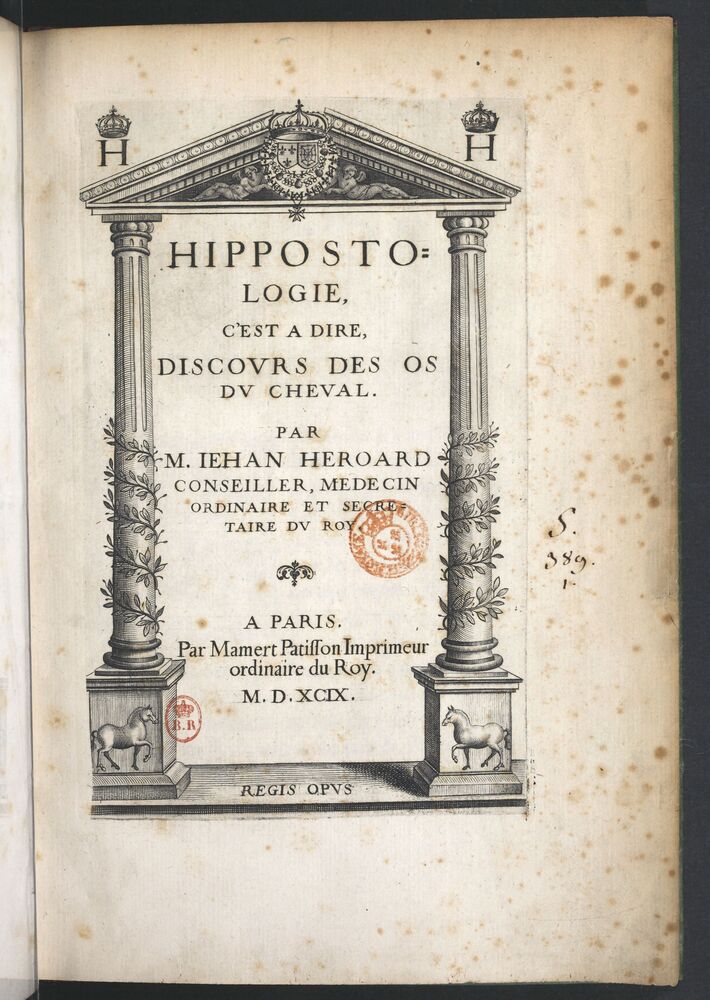
Hippostologie, c’est à dire Discovrs des os du Cheval. Par M. Iehan Heroard, Conseiller,
Médecin ordinaire et Secrétaire du Roy.
/
HÉROARD Jean
et
WEERT Jacob DE
|
|||||||||
|
|||||||||
| Français |
« Dans sa dédicace, Héroard dit que l’ouvrage lui fut commandé « quelques mois avant son decez, par le feu Roy Charles, lequel sur toutes choses prenoit un singulier plaisir a ce qui est de l’art Vétérinaire, duquel le subiect principal est le corps du Cheual... »
Ouvrage assez rare. » Mennessier de La Lance (1915-1921)
« Rare first and only edition of this interesting essay on the bones of the hors.
It is the first text in French on the anatomy of the horse. Originally intended as
a groundwork for a complete treatment of the veterinary medicine, the work was commissioned
by the horse loving King Charles XI (1550-1574) and can be considered supplementary
to the
Anatomia del cavallo
by
Carlo Ruini
, which appeared a year earlier in Bologna. That Heroard’s text is original and earlier,
however, is proven by a manuscript with the same text, dated 1579, in the library
of the Château de Chantilly.
The book is dedicated to King Henry IV (1553-1610, King from 1589) by Jean Heroard
and dated Paris, I January 1599. In this dedication (ff. 2r-4r) Heroart tells something
about the history of the realization of his book : « Et pour ceste raison le feu Roy
Charles lequel sur toutes choses prenoit un singulier plaisir à ce quei est de l’art
Veterinaire, duquel le subiect principal est le corps du Cheval, me commada quelques
mois avant son decez [1574) d’y employer une partie de mon estude, pour en dresser
après, quelque instruction aux mareschaux … ».
After a short introduction (ff. 1r-2r), the text starts with the treatment of the
bones of the skull, lower jaw and details: ‘Des os de la teste’ (ff. 2r-6r), ‘De la
Maschoire haute (et basse)’(ff. 6v-7v), ‘Des dents’ (ff. 7v-9r, with the first plate
with the ‘Figures des os de la teste’ on f. 8v. Then follow the chapters ‘De la Fourchette
du gosier’ (The frog of the horse; ff. 9r-9v), with a plate of ‘La Fourchette’ on
f. 9v; ‘De l’eschine’ (The spine of the horse; (ff. 10r-14v), with a plate of ‘l’eschine’
on f. 14r; ‘Du coffre’ (The cheste and sternum; ff. 14v-15v), with a plate of the
‘Coffre’ and ‘Lós de la Poictrine’ on f. 15v; ‘Desc extremitez (pieds)’ (ff. 16r-23v),
with a plate of ‘Le pied de devant / La Boëtte au Sabot’(The front leg and hoof) on
f. 20v, and ‘Le pied de derriere / La Boëtte au Sabot’ The hind leg and hoof) on f.
23r. The full-page plate of ‘Le corps des os du checval’ (Skeleton of the horse) is
on f. 24r (verso blank). The plates are engraved by Jacob de Weert (Antwerp 1569 –
Paris, after 1605) who was a pupil of Hieronymus Wierix and who moved to Paris c.
1597. These plates of the horse’s bones are copied many times, including in the editions
of Beaugrand and other works on horses published during the 17
th
century.
Jean Heroart was born in Hauteville-la-Guichard in 1551 from a protestant family of
physicians; he died during the siege of La Rochelle in 1628. In 1569 he came as veterinary
physician in the service of King Charles IX who loved hunting and everything connected
with horses. The King appointed him as ‘Médecin en l’Art vétérinaire’ in, or just
before 1574. It is the first time that the word ‘vétérinaire’ is used in French. Heroart
is also called the ‘premier vétérinaire français’. After having left the court in
1571, he became doctor of Medicine in Montpellier in 1575 and was appointed physician
of king Henry III, continued by Henry IV and later Louis XIII, who appointed him ‘premier
médecin’.
Heroart is most known for his famous Journal which he kept during 27 years. The six
volumes of this manuscript contain an exceptional, intimate, detailed, and very fascinating
eye witness report of French courtly life in the first quarter of the 17th century;
a modern edition was published by Madeleine Foisil in1989: Journal de Jean Héroard.
Publication du centre de recherche sur la civilisation de l’Europe moderne, 2 vols.
(Paris 1989).
Literature: Mennessier I, 617 (‘assez rare’); Nissen, ZBI 1909; Lacroix du Maine et
Duverdier IV, 444-5; plates: Hollstein LI, nos. 108-115. »
Dejager (2014)
: anatomie , ostéologie , squelette