The unearthed will of Guy Thibault
20 years on, a major unpublished work that is still relevant today
The racing season... Do horse races really have a season? Of course not. Just ups and downs! No sooner has the Deauville meeting ended than the Parisian racecourses, Auteuil for jump racing and Longchamp for flat racing, reopen their gates. In a few weeks' time, the cream of the thoroughbred selection from across the five continents of our planet is expected to compete in the Qatar Arc de Triomphe (5 October). More than a century after the first edition (1920), the legendary 2,400 metres to be covered at the Bois de Boulogne racecourse will be the focus of an immeasurable amount of energy, knowledge, talent, dedication, money, passion and, we are almost tempted to say, “ love ” !
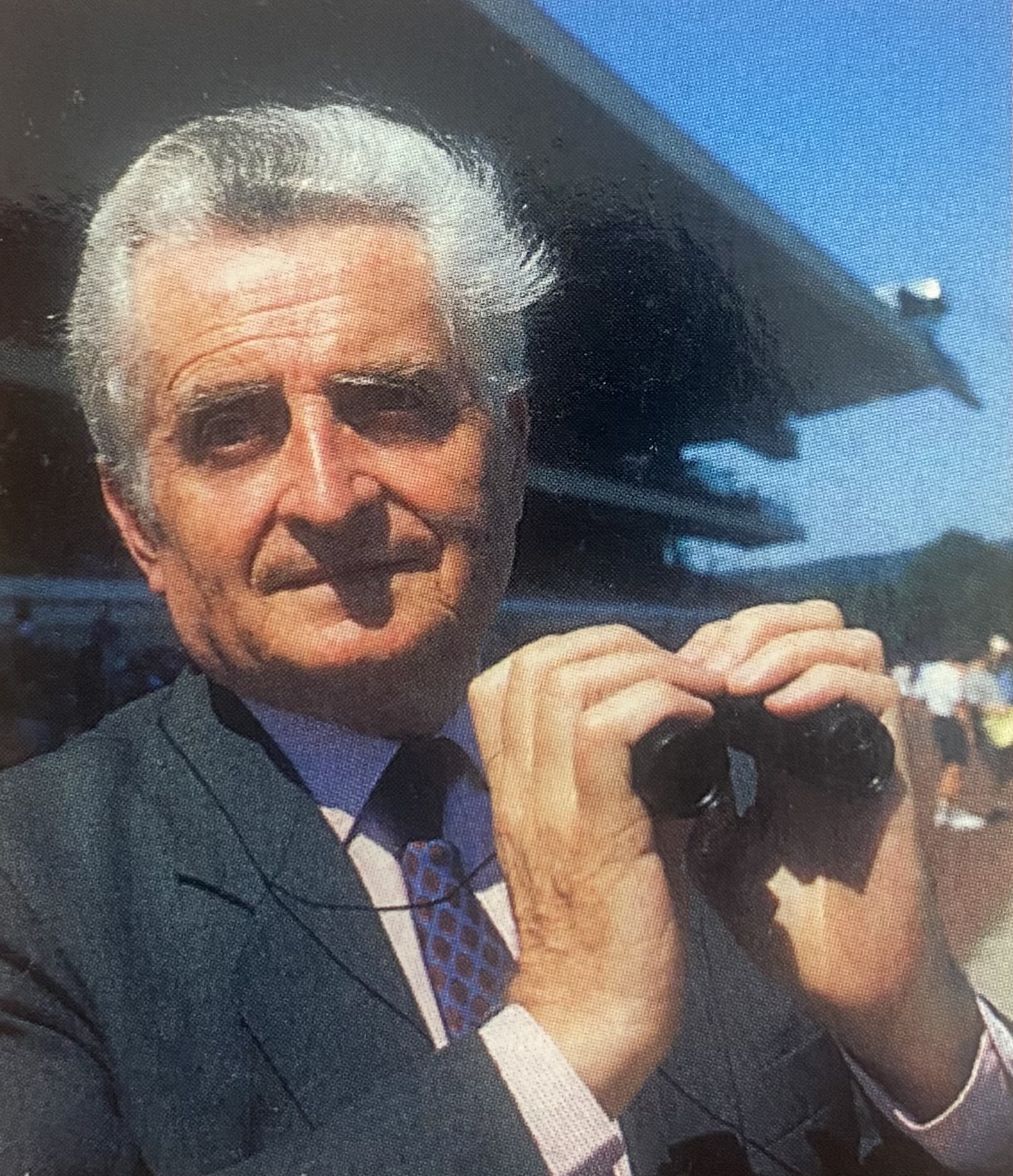
Many others before us have taken up the challenge, devoting their lives to the cause, to its study, to its defence, but also to its assets and its future. Among the latter is Guy Thibault. A keen expert on thoroughbred breeding and bloodlines, he was a broker and journalist, but above all a true racing historian who published more than fifteen books on the subject, all of which, regardless of the theme, were more thoroughly researched than any other at the time of publication. Guy Thibault passed away in 2005 at the age of 85. That was twenty years ago.
The witness, the expert, left behind a significant body of work on horse racing. He was a workaholic. Now that the industry is once again in turmoil, this is an opportunity for us to remember that history repeats itself... As it always has!
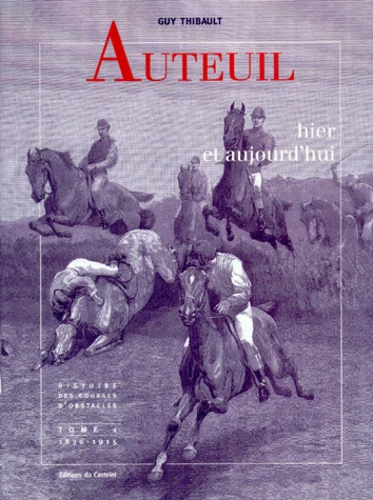
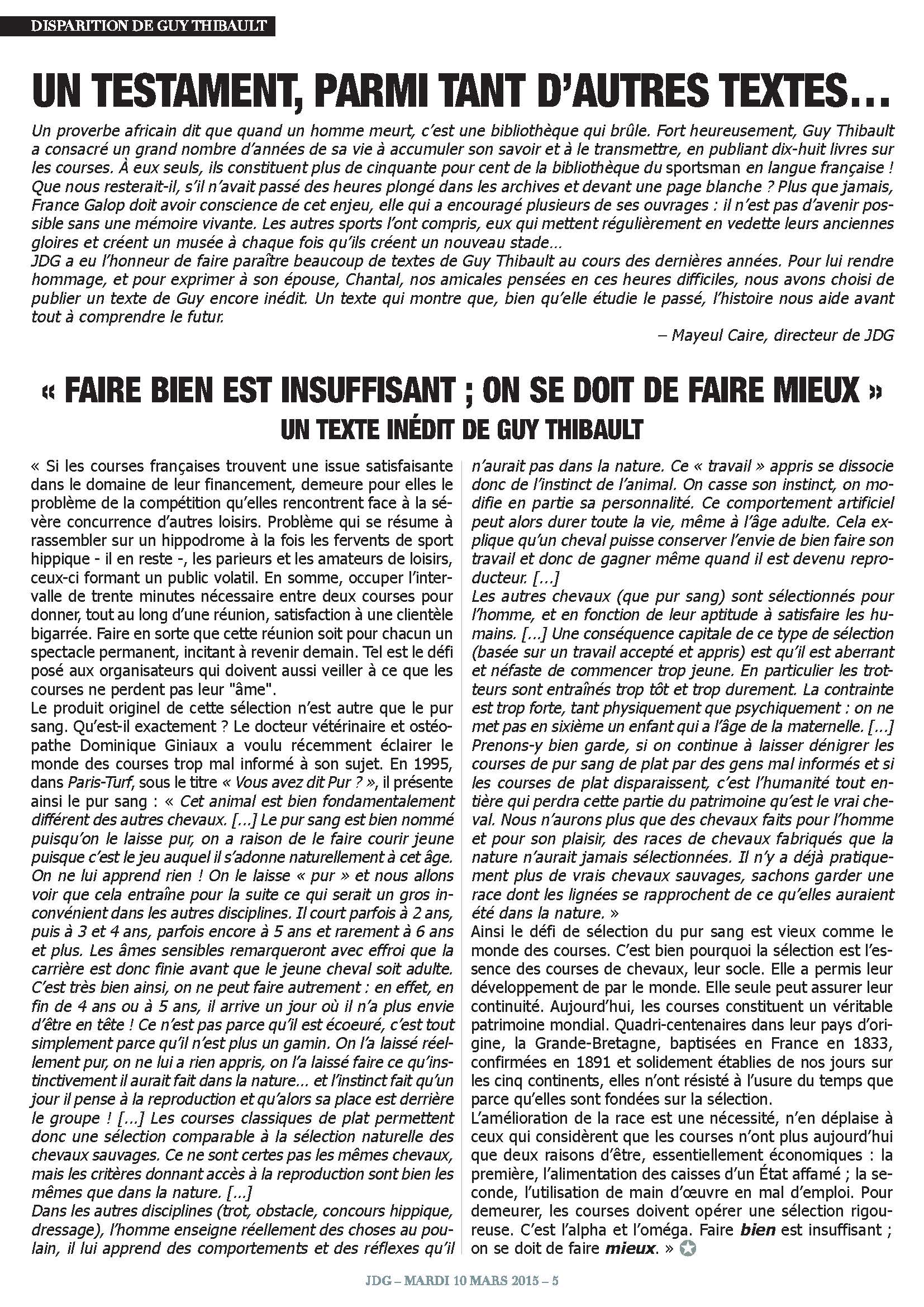
Let us recall his career, thanks to the special issue that Jour de Galop, the online daily newspaper launched by Mayeul Caire in 2007, dedicated to him the day after his death on 25 March of that year. The biography? More than three pages that we leave you to discover with the publisher's permission by clicking on the link below, Tribute to Guy Thibault. To be honest, we could hardly do better. His bibliography? You can also consult a large part of his collection on the website of the bibliothèque des Franciscaines de Deauville.
But, w hat caught our attention most in issue 2686 was the unpublished, exclusive text that Jour de Galop published on page 5. A full page that we invite you to rediscover in its entirety below, in its original form, that of the JdG layout at the time. Mayeul Caire presents it as ‘a testament’ and begins his tribute with an African proverb that says, ‘when a man dies, a library burns’. In fact, he has unearthed a little treasure and, above all, for those of us who are concerned about criticism of the pleasure we take in having fun on the backs of horses to their detriment, a beautiful argument, particularly with regard to the exploitation of racehorses and, in particular, thoroughbreds ‘exploited’ from the age of two (for flat racing). To do so, he quotes Dominique Giniaux, who died a year before him at the age of 60, a veterinarian and equine osteopath who was a tireless promoter of this new knowledge and his “ technique ”, defending what seemed indefensible: two-year-old colt racing! Ten years earlier, in 1995, in an article in Paris Turf entitled ‘Vous avez dit Pur ?’ (Did you say Thoroughbred?), he presented the thoroughbred in a way we had never thought of before:
“ This animal is fundamentally different from other horses. [...] The thoroughbred is aptly named because it is left pure, and it is right to race it young, since that is the game it naturally plays at that age.
We don't teach them anything! We leave them “pure” and we will see that this leads to what would be a major disadvantage in other disciplines. They sometimes race at 2 years old, then at 3 and 4 years old, sometimes even at 5 years old and rarely at 6 years old and above. Sensitive souls will note with dismay that their career is therefore over before the young horse reaches adulthood.
That's fine, there's no other way: at the end of its fourth or fifth year, there comes a day when it no longer wants to be in the lead! It's not because it's fed up, it's simply because it's no longer a kid. We've left it completely pure, we haven't taught it anything, we've let it do what it would have done instinctively in the wild... and instinct means that one day it thinks about reproduction and that its place is behind the group! [...] Classic flat races therefore allow for a selection process comparable to the natural selection of wild horses. They are certainly not the same horses, but the criteria for reproduction are the same as in nature. [...]. ”
An explanation, let's admit it, that we had never thought of before. In fact, flat racing is based on what could be called natural selection! It is not man who ‘pushes’ the foal, he merely nurtures it, allowing it to express its aptitude, its natural, primary instinct.
A fine argument; a solid one!
On the other hand, the section devoted to all other equestrian practices (racing) or equestrian sports is less relevant, less ‘practical’ in justifying the validity of the latter in the face of criticism from the inevitable detractors.
“ In other disciplines (trotting, show jumping, dressage), humans actually teach the foal things, teaching it behaviours and reflexes that it would not have in nature. This learned ‘work’ is therefore dissociated from the animal's instinct. We break its instinct and partially alter its personality. This artificial behaviour can then last a lifetime, even into adulthood. This explains why a horse can retain the desire to do its job well and therefore to win, even when it has become a breeding animal. [...] ”
In order for this “ work ” which is not natural to the horse (but then again, is it natural to humans in all areas of their existence?), to be acceptable in the eyes of third parties who are as innocent as they are incredulous, there is only one credo: education. There is only one rule: instil and demand from practitioners an ethic and values based on respect for the horse, which is also the only attitude, as Guy Thibault and Dominique Giniaux point out in their own way, that will enable the horse to give its best and provide the human who shares its life with satisfaction or at least the feeling of shared “ pleasure ”.
Xavier Libbrecht